
In the rapidly evolving digital landscape, artificial intelligence is transforming the way we create content, design visuals, and communicate ideas. One of the most powerful skills emerging from this revolution is prompt engineering—the art of crafting precise and descriptive instructions for AI systems. The difference between a raw vs optimized prompt can dramatically influence the quality of the output, especially in AI image generation. Understanding this distinction is essential for digital marketers, content creators, designers, freelancers, and beginners looking to harness the full potential of generative AI.
Understanding the difference between Raw vs Optimized Prompt is essential for anyone looking to unlock the full potential of AI-generated content. This comparison highlights how the quality of input directly influences the final output. A raw prompt is typically short and vague, offering minimal guidance to the AI model. For example, a simple instruction like “a snake in the forest” communicates the subject but lacks details about the environment, lighting, mood, or artistic style. As a result, the generated image may appear generic and lack emotional depth. In contrast, an optimized prompt provides a rich and structured description that guides the AI toward producing a more refined and visually compelling result, transforming a basic idea into a cinematic masterpiece.
To craft an effective optimized prompt, it is helpful to follow a simple framework that highlights the importance of the Raw vs Optimized Prompt approach. Begin by clearly defining the subject, then enrich the prompt with details about the environment and setting. Describe the lighting and mood to establish the emotional tone, and include stylistic or technical elements such as camera angles or artistic influences to refine the output. Finally, review and iterate the prompt to ensure continuous improvement. Understanding this progression from a raw prompt to an optimized prompt not only enhances the quality of AI-generated content but also deepens insight into how generative AI interprets human instructions.
Consider the comparison between these two prompts. The raw prompt, “a snake in the forest,” may generate a standard image with limited detail. However, an optimized version such as “a vibrant emerald green tree python coiled around a rainforest branch during a misty sunrise, with water droplets on its scales, dramatic golden backlighting, cinematic composition, macro photography, and shallow depth of field” results in a far more captivating and professional visual. This example clearly illustrates how writing better prompts enhances AI creativity and ensures more consistent outcomes.
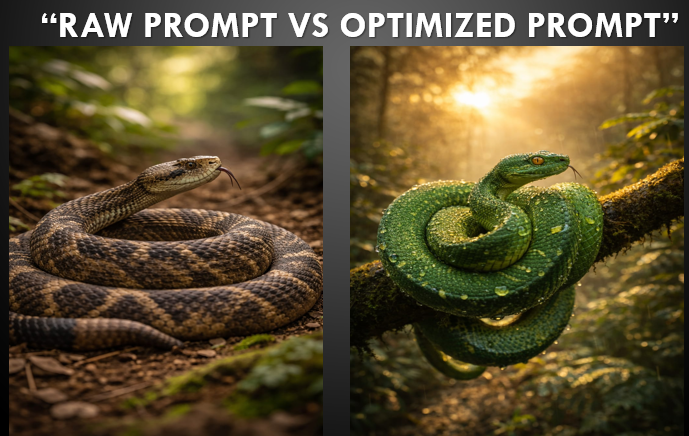
The effectiveness of raw vs optimized prompts lies in their ability to provide context and clarity. When AI models receive detailed instructions, they can better interpret the user’s intent and produce outputs that align closely with the envisioned result. Elements such as subject, environment, lighting, mood, and artistic style play a crucial role in shaping the final image. For instance, mentioning “golden sunrise lighting” introduces warmth and emotion, while specifying “macro photography with shallow depth of field” enhances realism and focus. These subtle yet powerful additions significantly elevate the quality of AI art.
Another important advantage of optimized prompts is the level of creative control they offer. With a raw prompt, the outcome is often unpredictable, requiring multiple iterations to achieve the desired result. Optimized prompts, on the other hand, reduce ambiguity and increase consistency, saving both time and effort. This precision is particularly valuable for professionals in digital marketing and content creation, where high-quality visuals are essential for audience engagement and brand storytelling. By mastering prompt design, creators can efficiently produce compelling content that stands out in a competitive digital environment.
To craft an effective optimized prompt, it is helpful to follow a simple framework that highlights the importance of the Raw vs Optimized Prompt approach. Begin by clearly defining the subject, then enrich the prompt with details about the environment and setting. Describe the lighting and mood to establish the emotional tone, and include stylistic or technical elements such as camera angles or artistic influences to refine the output. Finally, review and iterate the prompt to ensure continuous improvement. Understanding this progression from a raw prompt to an optimized prompt not only enhances the quality of AI-generated content but also deepens insight into how generative AI interprets human instructions.
Despite its benefits, beginners often make common mistakes when writing prompts. Being too vague is one of the most frequent errors, as it limits the AI’s ability to generate detailed results. Conversely, overloading a prompt with excessive or conflicting information can confuse the model and lead to inconsistent outputs. Striking the right balance between clarity and conciseness is key. Additionally, failing to specify the desired style or mood may result in images that do not align with the intended vision. By avoiding these pitfalls, users can significantly improve the effectiveness of their prompts.
The impact of prompt engineering extends far beyond AI image generation. In digital marketing, optimized prompts enable the creation of personalized advertisements, engaging social media content, and visually appealing brand assets. Designers can rapidly prototype concepts, while freelancers can enhance their service offerings and productivity. As generative AI continues to evolve, the ability to communicate effectively with these systems will become an increasingly valuable skill across industries. The Raw vs Optimized Prompt comparison serves as a powerful reminder that the quality of input directly determines the quality of output.
Looking ahead, prompt engineering is poised to play a pivotal role in the future of digital innovation. Advances in multimodal AI, real-time content generation, and personalized user experiences will further expand its applications. Businesses and creators who invest time in mastering this skill will gain a significant competitive advantage. Moreover, as AI tools become more accessible, the demand for professionals skilled in writing better prompts is expected to grow, making it an essential competency in the modern digital economy.
In summary, the distinction between a raw prompt and an optimized prompt underscores the transformative potential of prompt engineering. While a raw prompt provides only a basic idea, an optimized prompt delivers clarity, context, and creative direction, resulting in visually stunning and professional-quality outputs. By understanding and applying the principles discussed in this article, beginners and experienced creators alike can unlock new levels of AI creativity and efficiency. The journey toward mastering generative AI begins with a single, well-crafted prompt.
Frequently Asked Questions
1. What is prompt engineering?
Prompt engineering is the process of crafting precise and descriptive instructions to guide AI systems in generating accurate and high-quality outputs.
2. Why are optimized prompts better than raw prompts?
Optimized prompts provide context, clarity, and creative direction, resulting in more detailed, consistent, and visually appealing outputs.
3. Can beginners learn prompt engineering easily?
Yes, with practice and a structured approach, beginners can quickly develop the skills needed to create effective prompts.
4. How does prompt engineering benefit digital marketers?
It enables the creation of engaging visuals, personalized campaigns, and high-quality content, enhancing brand communication and audience engagement.
Conclusion
The comparison of Raw vs Optimized Prompt clearly demonstrates that the effectiveness of AI-generated content depends heavily on the quality of the input. By embracing prompt engineering and applying structured techniques, creators can transform simple ideas into compelling visual narratives. As generative AI continues to reshape the digital landscape, mastering this skill will open doors to new creative and professional opportunities.